x402 Exception Desk: Queueing Payment Exceptions on Base
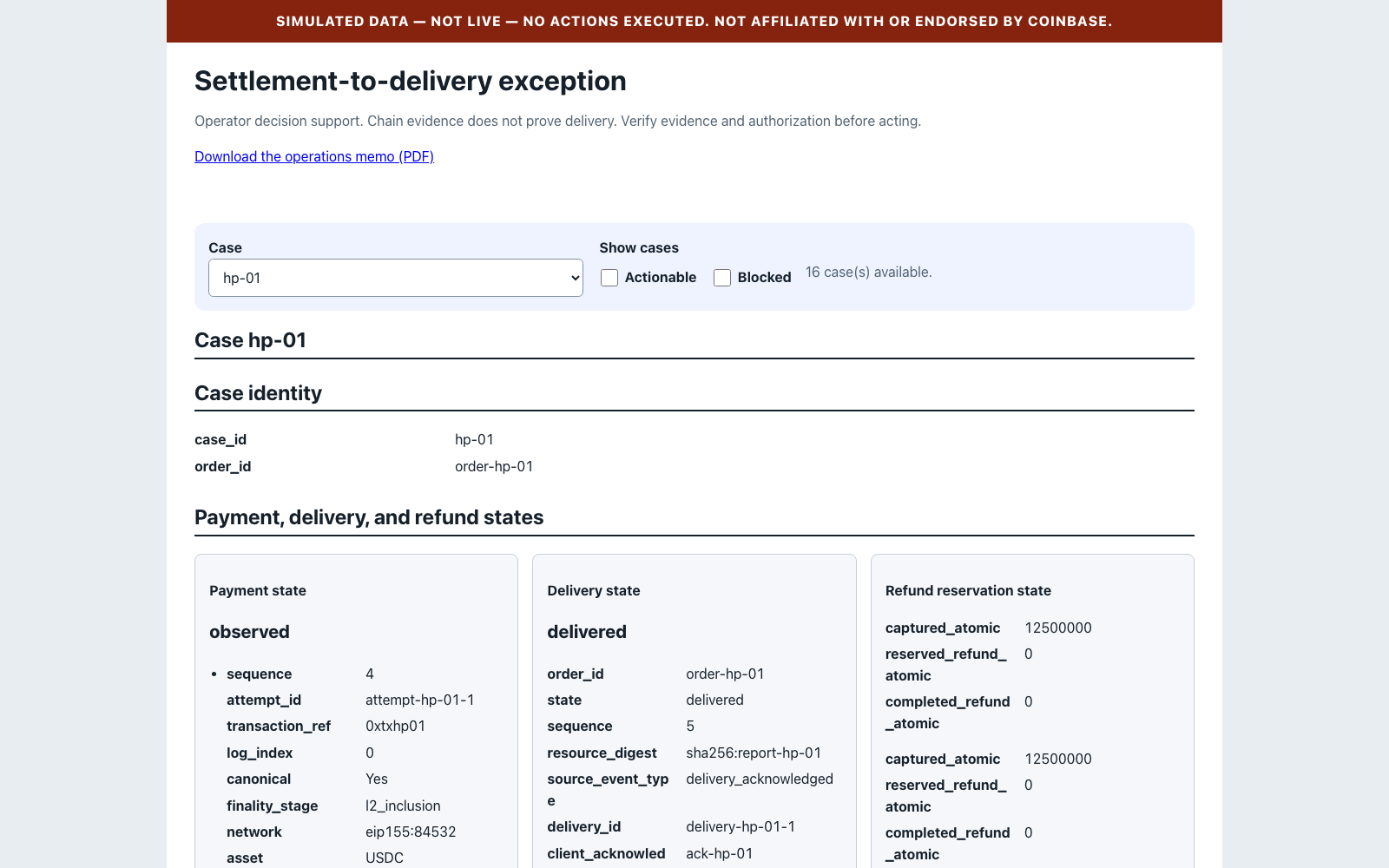
A synthetic settlement-to-delivery exception desk for x402 payments on Base: 65 events across 16 incidents through one deterministic reducer, four queue policies compared, and a 3,600-scenario sweep showing no policy wins every objective.
- Problem
- When a payment settles on chain but the paid-for resource never arrives, or a request times out with no clear outcome, an operator has to decide which case to handle first and what evidence makes a retry, recovery, refund, or closure safe. A wrong call can charge a customer twice or treat an approved refund as settled.
- Solution
- Built a standard-library Python desk where an append-only SQLite event log is the evidence boundary. One deterministic reducer turns synthetic events into case states, a separately written oracle checks every incident, and four queue policies run on the same workload and across a 3,600-scenario sweep. A 26-check consistency gate ties every generated file to one run.
Overview
The question: When payment evidence and delivery evidence disagree on an x402 payment, which case should an operator handle first, and what evidence makes a retry, recovery, refund, or closure safe?
The answer: Keep FIFO. The proposed deadline-first queue cut value-weighted overdue time by 64% but left the same 6 cases overdue, so it failed a gate set before the run. Across 3,600 scenarios no policy wins every objective, so the queue rule should follow from the objective a team picks.
Scope: All data is synthetic. The desk makes no live payments. Independent project, not affiliated with or endorsed by Coinbase, and it does not describe any Coinbase system or process.
The Problem
For an x402 payment on Base, payment and delivery are separate facts, and they can disagree: the chain shows a payment but the resource never arrived, a request times out with no clear result, or a refund is approved but not yet settled. Each disagreement becomes a case an operator has to resolve.
The state model keeps four facts apart:
- A timeout means the outcome is unknown, not failed, so it never triggers a new charge.
- Chain evidence shows payment, not delivery.
- A refund approval reserves balance but is not a settled refund.
- One piece of payment evidence cannot pay for two orders.
The Answer
The desk replays 65 synthetic events across 16 incidents, then runs the 9 actionable cases through four queue policies on the same workload:
| Policy | Overdue cases | Median delay (min) | p95 delay (min) | Value-weighted overdue (USDC-minutes) | Control failures |
|---|---|---|---|---|---|
| FIFO (baseline) | 6 | 66.1 | 107.1 | 4,428.9 | 0 |
| Deadline-first (proposed) | 6 | 55.1 | 107.1 | 1,582.2 | 0 |
| Value-first | 4 | 47.1 | 137.1 | 1,371.9 | 0 |
| Hybrid (SLA window, then value) | 4 | 77.1 | 127.1 | 982.1 | 0 |
Deadline-first had to cut overdue cases by at least 15% with zero control failures. It did not. Value-first and hybrid cut overdue cases to 4, but they were added after the gate was set, have not run on a held-out workload, and have a worse p95 delay than FIFO.
The sweep
3,600 scenarios: 100 seeds x 1 to 3 operators x 0.5x/1x/2x handling time x evidence delay x finality delay. Share of scenarios where each policy had the best result:
| Objective | FIFO | Deadline-first | Value-first | Hybrid |
|---|---|---|---|---|
| Fewest overdue cases | 9.7% | 20.8% | 51.7% | 17.8% |
| Least value-weighted overdue time | 7.4% | 22.0% | 30.1% | 40.5% |
| Lowest p95 delay | 50.0% | 11.1% | 17.6% | 21.3% |
Ties split the credit. Control failures tie at 25% each because the seeded failures belong to the workload, not to the queue order.
How It Was Built
Approach
- The event log is the evidence boundary. An append-only SQLite store holds the events, and every projection, reconciliation row, operator view, and policy result derives from them.
- One deterministic reducer. Events are grouped by case and reduced to payment, delivery, and refund state, with the allowed and forbidden next actions for each case.
- Payment shapes from the public spec. Events follow the public x402 v2 specification and Base finality documentation.
- Standard library only. No third-party Python packages.
Checks
- A separately written oracle states the expected outcome of all 16 incidents. The reducer matches it 16 of 16.
- A 26-check consistency gate ties every generated file to one run ID and to the fixture, oracle, and workload hashes.
- A release script runs the tests, regenerates outputs, runs the gate, checks the memo, workbook, and video against recorded hashes, and rebuilds a deterministic release archive. CI runs it on Python 3.9 and 3.11.
What to Open First
- Operator report: rahilbhavan.github.io/x402-exception-desk. Each case’s evidence timeline, payment, delivery, and refund state, and the policy comparison.
- Decision memo (PDF): the policy decision and the strongest argument against FIFO.
- Repository: github.com/RahilBhavan/x402-exception-desk. The reducer, oracle, state model, and operator runbook.
Scope & Limits
- All data is synthetic: incidents, amounts, identities, handling times, arrival rates, and every result.
- No live payments. The desk uses no wallet, signs nothing, calls no facilitator, and sends no transactions.
- Handling times are model inputs, not measurements, so the policy results show tradeoffs, not a production recommendation.
- No payments practitioner has reviewed the workflow yet.
- Independent project, not affiliated with or endorsed by Coinbase, and it does not describe any Coinbase system or process.
Completed: September 23, 2026